|
The
Potential for Tsunami Generation in the Eastern Mediterranean
Basin and in the Aegean and Ionian Seas in Greece
George
Pararas-Carayannis

 Introduction Introduction
Destructive earthquakes
and tsunamis have ravaged the Eastern Mediterranean Basin, the
Greek mainland and the islands of the Aegean and Ionian Seas.
Large destructive earthquakes and tsunamis resulted in extensive
destruction of the Minoan and early Greek settlements (Pararas-Carayannis,
1973). The following is a brief overview of major historical
tsunamis in Greece and the potential for tsunami generation from
large earthquakes in the region.
The Palaces of the
Minoan Empire at Knossos, Crete, were destroyed by large earthquakes
in the 1700's B.C., were rebuilt but damaged again by subsequent
earthquakes and tsunamis associated with the explosion/collapse
of the Santorin volcano in 1490 B.C.

Geological
Instability of the Eastern Mediterranean Basin and Potential
for Large Tsunamigenic Earthquakes in the Aegean and Ionian Seas.
The eastern Mediterranean
basin where the Anatolian plate extends, is one of the world's
most intense seismic zones where large destructive earthquakes
occur with frequency. The geological instability and the resulting
earthquakes are caused by the active grinding of the Anatolian
plate wedged against the continental plates of Africa, Eurasia
and Arabia. As these larger tectonic plates grind against the
Anatolian plate, Asia Minor and Greece move, smashing closer
together in some places and drawing apart in other regions.
 Seismicity of Greece - Supeimposed
is the Epicenter of the September 7, 1999 earthquake- Modified
USGS map) Seismicity of Greece - Supeimposed
is the Epicenter of the September 7, 1999 earthquake- Modified
USGS map)
The 500-mile North
Anatolian fault marks the northern boundary of the Anatolian
plate grinding against the Eurasian plate. This great fault zone
appears to be moving eastward at the present time. At its western
end it impacts on the North Aegean fault, a volcano-dotted undersea
rift that runs down the middle of the Aegean Sea. The fault zone
then meanders under Greece and heads up the Ionian and Adriatic
Seas. As a result of active interaction and movement along these
major faults, hundreds of earthquakes of all sizes are recorded
every year throughout this region. Since 1964, more than 20,000
quakes have been recorded around Greece alone.

Modified
After Nafi Toksoz of MIT/ERL
Historical
Tsunamis In Greece - The Potential for Tsunami Generation in
the Aegean and Ionian Seas.
Of a total of 613
known historic earthquakes, at least 41 major events generated
documented tsunamis that struck coastal areas of the Greek mainland
and the Aegean islands. Sixteen of these earthquakes resulted
in really damaging or disastrous tsunamis. Between 1801 and 1958,
482 earthquakes with intensity equal or greater than VI, and
170 with intensity greater than VIII occurred. Twenty of these
earthquakes resulted in tsunamis and six of these tsunamis were
particularly damaging or disastrous in the Aegean and the Eastern
Mediterranean Sea (Galanopoulos, 1960).
 Thus,
the occurrence of large tsunamis is quite usual for the Eastern
Mediterranean and the Aegean Sea. Most of the large historical
earthquakes are associated with the seismic zone of the convex
side of the Hellenic arc (Hellenic Trench) (Papazachos et al.,
1985, 1986). Thus,
the occurrence of large tsunamis is quite usual for the Eastern
Mediterranean and the Aegean Sea. Most of the large historical
earthquakes are associated with the seismic zone of the convex
side of the Hellenic arc (Hellenic Trench) (Papazachos et al.,
1985, 1986).
Extension and normal
faulting within the Aegean plate are consistent with a NE-SW
trending graben along which the Santorin volcanic field has developed.
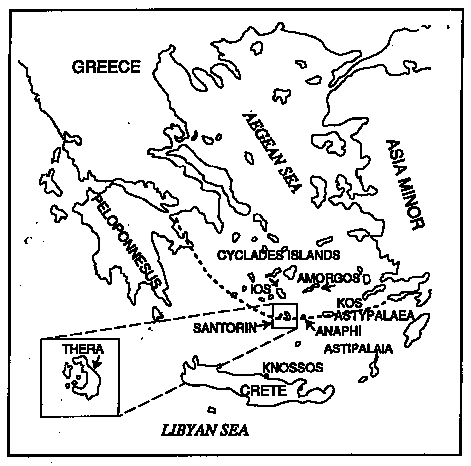
Most of the larger destructive tsunamis in Greece have originated
from this region of the Hellenic arc, near the island of Santorin
(see map).
There is substantial
historical evidence that large earthquakes near the island of
Crete were responsible for the destruction of the Minoan palaces
of the island, including Knossos. The first major destruction
of the Palace of Knossos by earthquakes occurred around 1720
BC. After the palace was rebuilt and restored to its original
splendor, it was again destroyed by the earthquakes of the fourteenth
century BC (Pararas-Carayannis, 1974). Tsunamis were responsible
for subsequent destruction.
 A number of catastrophic sea
waves were generated from these early earthquakes and from the
gradual collapse of the Santorin volcano over a period of time.
The final explosion and collapse of the volcano of Santorin in
1490 B.C. generated a much larger tsunami, or a series of tsunamis,
that inundated the coastal towns of Crete and acted as the catalyst
in the declination of the Minoan civilization (Pararas-Carayannis,
1973). There is conclusive evidence that Minoan cities on the
north and east coast of the island of Crete were also struck
by huge tsunami waves (Marinatos, 1939). These included Amnisos,
Malia, Niron Chani, Psira, Ghoumia, and Zakros. A number of catastrophic sea
waves were generated from these early earthquakes and from the
gradual collapse of the Santorin volcano over a period of time.
The final explosion and collapse of the volcano of Santorin in
1490 B.C. generated a much larger tsunami, or a series of tsunamis,
that inundated the coastal towns of Crete and acted as the catalyst
in the declination of the Minoan civilization (Pararas-Carayannis,
1973). There is conclusive evidence that Minoan cities on the
north and east coast of the island of Crete were also struck
by huge tsunami waves (Marinatos, 1939). These included Amnisos,
Malia, Niron Chani, Psira, Ghoumia, and Zakros.
Nothing is definitely
known about the height of the Bronze Age tsunami on other Aegean
Islands but estimates were made based on field collected data.
A rough estimate of the Santorin tsunami at Anaphi island, the
closest to the origin, was extrapolated from the 7 m tsunami
(corrected for eustatic change), as documented at Jaffa-Tel Aviv,
900 km away (Pararas-Carayannis, 1992 ). This estimate, based
upon geometrical dispersion, neglecting effects of refraction,
diffraction, or resonance, results in a height of 42 m, consistent
with the 40-50 m elevation at which pumice deposits were found
by Marinos and Melidonis (1959). The highest possible tsunami
wave at the source could not have exceeded 50 m (Pararas-Carayannis
1992 ).
Following the eruption and collapse of the volcano of Santorin
many more tsunamis occurred in the Aegean Sea. For example, in
AD 365, a destructive tsunami struck the Island of Crete and
was reported as far as Alexandria, where ships were carried inland
and left in the streets of the city.
On 26 September 1650,
a destructive earthquake was accompanied by a submarine explosion
from the Colombo Volcano, whose crater lies in the sea on the
northeast of the island of Santorin. There was a devastating
tsunami observed on the island of Ios, north of Santorin, and
waves of up to 16 m were reported.
In 1672, the islands
of the Cyclades, and particularly Santorin, were again shaken
by an earthquake. The island of Kos, to the east, was reported
to have been swallowed up presumably by the resulting tsunami.
The best documented
and most recent tsunamigenic earthquake in the Aegean Sea is
the one that occurred on 9 July 1956 near the southwest coast
of the island of Amorgos, killing 53 people, injuring 100, and
destroying hundreds of houses (Galanopoulos, 1957). The waves
were particularly high on the south coast of Amorgos and on the
north coast of the island of Astypalaea. At these two places
the reported heights of the tsunami were 25 and 20 m, respectively
(Galanopoulos, 1960).
These are only a few
examples of tsunamis in Greece. There have been many more events
in the Aegean and Ionian Seas as well as in the Gulf of Corinth.
References
Galanopoulos, A.
G.: 1957, The seismic
sea wave of July 9, 1956, Prakt. Acad. Athenes 32, 90-101.
Galanopoulos, A.
G.: 1960, Tsunamis
observed on the coasts of Greece from antiquity to present time, Annali
de Geofisica X111, - 4), Rome, 371-386.
Papazachos, C. B.,
Koutitas, C. H., Hatzidimitriou, M. P., Karacostas, G. B., and
Papaioannou, A. Ch. 1985, Source and short-distance propagation
of the July 9, 1956 southern Aegean tsunami,
letter section, Marine
Geol. 65, 343-351.
Papazachos, C. B.,
Koutitas, C. H., Hatzidimitriou, M. P., Karacostas, G. B., and
Papaioannou, A. Ch: 1986, Tsunami
hazard in Greece and the surrounding area, Ann. Geophys. 4 (B1), 79-90.
Pararas-Carayannis,
G., 1973, The waves
that destroyed the Minoan empire, Sea Frontiers 19(2), 94-106.
Pararas-Carayannis,
G., 1974, The waves that destroyed the Minoan empire,
Revised for Grolier Encyclopedia, Science Supplement, Man and
His World, pp. 314-321.
Pararas-Carayannis,
G., The Tsunami Generated from the Eruption of the
Volcano of Santorin in the Bronze Age
Natural Hazards 5::115-123,1992.
1992 Kluwer Academic Publishers (Netherlands.)
RETURN TO
  Links to other
Pages
Links to other
Pages

 Now available from Amazon, Barnes
and Noble and other major bookstores. A signed by the author
copy can be also ordered by contacting directly by email Aston Forbes
Press.
Now available from Amazon, Barnes
and Noble and other major bookstores. A signed by the author
copy can be also ordered by contacting directly by email Aston Forbes
Press.
 Other
Miscellaneous Non-technical Writings
Other
Miscellaneous Non-technical Writings
(©) Copyright
1963-2007 George Pararas-Carayannis / all rights reserved / Information
on this site is for viewing and personal information only - protected
by copyright. Any unauthorized use or reproduction of material
from this site without written permission is prohibited.
|