Numerous tsunamis with short and longer wave periods were generated by complex mechanisms associated with the paroxysmal Plinian and Ultra-Plinian phase of the Bronze Age eruption and collapse of the volcano of Santorin. Based on an approximate reconstruction of volcanic mass edifice failure geometries, from sector caldera and flank collapses, and from estimates of volumes and time scales of resulting kinematic processes - as inferred from geologic evidence and recent geophysical findings - the near and far-field characteristics of the tsunamis are evaluated.
A sequence of explosions involving vertical and lateral blasting episodes, atmospheric pressure pertrubations, a cone collapse sequence, and mass edifice flank failures of the Volcano of Santorin - before, during and after the paroxysmal phase of its Bronze Age eruption in 1650 B.C. (+/- 50 years) - account for the catastrophic tsunami waves in the Aegean Archipelago and the Eastern Mediterranean during that period.
Destructive waves that affected the entire region were generated by volcanic hydromagmatic explosions and caldera collapses of the volcano of Santorin, and by volcanically, seismically or gravitationally induced aerial or submarine landslides and rock falls of the island.
Violent pyroclastic and hydromagmatic explosions, primarily during the third phase of the eruption, generated long and short period atmospheric pressure pertrubations which, in turn, generated a series of destructive waves by coupling with the sea surface. The massive caldera collapses and edifice flank flank failures and seismic events, after the paroxysmal phase of Santorin's eruption, contributed to the generation of additional destructive tsunami waves.
The volcano's final caldera collapse and the massive flank failures resulted from gravitational instability and may have been triggered by one or more earthquakes along the NE-SW trending normal fault in the Aegean Sea where the Santorin volcanic field has developed. Such extensive loss of land mass and source mechanism can account for the size and destructiveness of the Bronze Age tsunamis in the Southern Aegean Sea - with the interesting archaeological and historical implications about the declination of the Minoan civilization and Plato's legend of the "lost land of Atlantis" in the incomplete "Critias" dialog.

INTRODUCTION
Numerous large destructive earthquakes and tsunamis have occurred from antiquity to the present in the Eastern Mediterranean Sea and particularly in the Aegean Archipelago. There is historical evidence that such large destructive earthquakes and tsunamis have ravaged the Aegean islands and the Greek mainland, resulting in extensive destruction of the Minoan and early Greek settlements (Pararas-Carayannis, 1973).
 Of a total of 613 known historic earthquakes, at least 41 major events generated documented tsunamis that struck the coasts of Greece. Sixteen of these resulted in damaging or disastrous tsunamis. Between 1801 and 1958, 482 earthquakes with intensity equal or greater than VI, and 170 with intensity greater than VIII occurred. Twenty of these earthquakes resulted in tsunamis, and six of these tsunamis were particularly damaging or disastrous in the Aegean and the Eastern Mediterranean Sea (Galanopoulos, 1960).
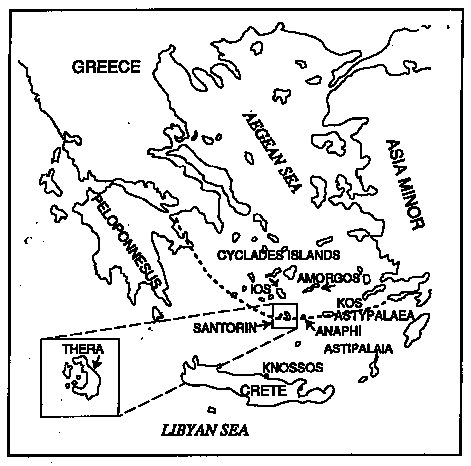
Thus, the occurrence of large tsunamis is quite usual for the Eastern Mediterranean and the Aegean Archipelago. Many destructive tsunamis originated from a the Hellenic arc region near the island of Santorin. In AD 365 a destructive tsunami struck the Island of Crete and was reported as far as Alexandria, where ships were carried inland and left in the streets of the city. On 26 September 1650, a destructive earthquake was accompanied by a submarine explosion from the Colombo Volcano, whose crater lies in the sea on the northeast of the island of Santorin. There was a devastating tsunami observed on the island of Ios, north of Santorin, and waves of up to 16 m were reported. In 1672, the islands of the Cyclades, and particularly Santorin, were again shaken by an earthquake. The island of Kos, to the east, was reported to have been "swallowed up" presumably by the resulting tsunami. The best documented and most recent tsunamigenic earthquake is the one that occurred on 9 July 1956 near the southwest coast of the island of Amorgos, killing 53 people, injuring 100, and destroying hundreds of houses (Galanopoulos, 1957). The waves were particularly high on the south coast of Amorgos and on the north coast of the island of Astypalaea. At these two places the reported heights of the tsunami were 25 and 20 m, respectively (Galanopoulos, 1960).
Fig. 1. Location map showing Thera (Santorin) and the Aegean Volcanic chain (dotted line)
Of all the historical tsunamis in the region, the best known but least documented has been the one associated with the explosion-collapse of the volcano of Santorin during its paroxysmal Bronze Age eruption in 1650 B.C. (+/- 50 years). There is a great deal of speculation about the effects of this tsunami on the ancient world, but little is known about its source mechanism, the time history of events leading to its generation, and of the maximum wave height distribution in the Eastern Mediterranean. Most studies have attributed this tsunami to the explosion-collapse of the volcano of Santorin in forming a large submarine caldera. Although large tsunamis can be generated by such explosion-caldera collapse, this mechanism alone cannot account for the large destructive tsunami waves that occurred in the Aegean and the Eastern Mediterranean Seas during that period.
Based on recent geological and geophysical findings, the following is an examination and analysis of the Bronze Age tsunami waves that were generated by a sequence of explosions, atmospheric pressure pertrubations, a cone collapse sequence, and mass edifice flank failures of the volcano of Santorin - before, during and after the paroxysmal phase of its eruption in 1650 B.C. (+/- 50 years). This sequence of catastrophic events, preceeded by major earthquakes in the 17th B.C. century, can account about the destruction of the palaces at Knossos and elsewhere on the island of Crete, for the gradual declination of the Minoan civilization, and for the legendary "lost land of Atlantis".
SOURCE MECHANISM OF VOLCANICALLY GENERATED TSUNAMIS
Volcanic eruptions accompanied by mass edifice flank failures and explosion-collapse processes in forming submarine calderas, are very efficient tsunami generators. However, volcanic edifice failure events involve relatively small volumes of mass and the tsunami or tsunami-like waves they generate are of short periods and wavelengths. Although these waves may be catastrophic locally, their heights attenuate rapidly as they propagate away from the source.
 Tsunami and tsunami-like waves from volcanic sources have complex generation mechanisms. Destructive water waves may be generated by the explosion and collapse of a volcanic cone in forming an underwater caldera, by the coupling of volcanically-generated atmospheric shock waves with the sea surface, by massive flank failures, by debris avalanches, and by massive aerial and submarine landslides. To understand the volcanic tsunami generation mechanism, we must examine submarine caldera formation processes and all other related concurrent geotectonic activity that takes place before, during and after a volcano's paroxysmal eruption or mass edifice collapse.
It is generally accepted that volcanic calderas of the Krakatoan type are formed by the engulfment of the unsupported upper volcanic cone into the drained magmatic chambers below. However, this theory lacks detail and is somewhat contradictory to evidence. For example, it has bean observed that the volume of ejected pumice and other pyroclastic debris is often considerably less than the volume of the caldera depression. Therefore, the volume discrepancy suggests a possible mechanism for the explosive removal of the upper volcanic cone, rather than its total engulfment, or perhaps a combination of the two processes. This in turn is related to tsunamigenic efficiency.
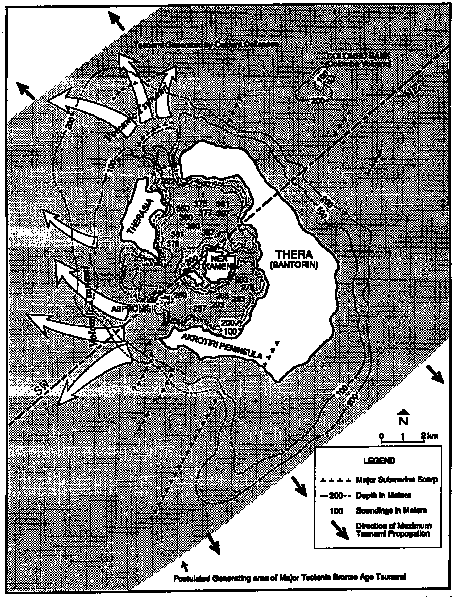
Fig. 2. Map of the Thera (Santorin) volcanic field, indicating source areas of volcanic tsunamis and postulated generating area of major tectonic tsunami.
Also, it is not known with certainty whether the volcanic collapse phase is sudden and total, or periodic and partial. The time-history of caldera collapse and its geometry are very important in understanding the tsunami source mechanism. Similarly, the triggering mechanism of the last violent paroxysmal eruptive phase of the volcano is not clear. It is not known with certainty if this phase is purely hydromagmatic in origin, the result of extreme gaseous pressures building below high viscosity magmatic residues or a combination of the two processes.
Furthermore, certain other large depressions that resemble Krakatoan calderas - though associated with regional volcanic activity - result from tectonic subsidence along fractures controlled by regional fault patterns which may create step faultings and double pit craters as those observed on the volcano of Kilauea on the island of Hawaii and on the Piton De La Fournaise volcano on Reunion island in the Indian Ocean. Such fault patterns may be localized along ring fractures and may indeed form circular caldera-like depressions, but may also be associated or triggered by earthquakes or larger tectonic displacements along major fracture zones. This may have been the case for the volcano of Santorin during its Bronze Age eruptive sequence. Large tectonic displacements caused by a large earthquake in the area could have triggered the final collapse of the cone, the formation of the large caldera, and the mass edifice failures which generated the destructive Bronze Age tsunami or tsunamis.
SOURCE MECHANISM OF THE BRONZE AGE TSUNAMI(s) IN THE AEGEAN ARCHIPELAGO AND THE EASTERN MEDITERRANEAN SEA
 It is not known how high the waves of the Bronze Age tsunami were, but researchers (Marinos and Melidonis, 1959) found evidence of inundation on the west side of the island of Anaphi - wich is 25 km east of the island of Santorin - at heights ranging from 40 to 50 m above sea level. Other evidence of tsunami inundation was presumably found as high as 160 and 250 m on the northeastern side of the same island. At a greater distance away from Santorin, evidence of the tsunami height was found at 5 m above sea level north of Jaffa-Tel Aviv. This tsunami height - when corrected for eustatic change in sea level in the Mediterranean for the last 3500 years - would have been at least 7 m during the Bronze Age.
Fig. 3. Vent development and caldera collapse during the four phases of the Minoan eruption of the Volcano of Santorin (after Heiken and McCoy, 1984).
Could the tsunami generated by the explosion/collapse of the volcano of Santorin - or any tsunami for that matter - have been as high as 160 and 250 m on the northeastern side of the island of Anaphi ? Such tsunami runup appears to be extremely unreasonable for either tectonically or volcanically generated tsunamis on any open coastline. In view of recent studies of the Santorin caldera formation , and other geophysical measurements and observations, the following is an evaluation of the tsunami source mechanism from caldera collapse alone.
The extension and normal faulting within the Aegean plate are consistent with a NE-SW trending graben along which the Santorin volcanic field has developed (Figure 2). Eruptions of Santorin have occurred from fissures located within this graben. Furthermore, there is evidence of a much older flooded pre-Minoan caldera present on the southern half of the volcanic field of Santorin before the 1490 BC eruption (Heiken and McCoy,1984). This caldera was approximately 5- 6 km in diameter. The original depth of this caldera is not known, but its present average depth is 280 m. The presence of this preMinoan caldera would reduce the volume of the Minoan caldera to 19 km3, which is reasonably close to the estimated volume of magma extruded during the Minoan eruption (Watkins et al. (1978), namely between 13 and 18 km3 (dense rock equivalent). Furthermore, the vent development and caldera collapse occurred in four phases (Figure 3) (Heiken and McCoy,1984). Thus, a long-time history of caldera collapse is inferred.
SCENARIO AND THE TIME-HISTORY OF SANTORIN's BRONZE AGE EXPLOSIVE ERUPTION AND MASS EDIFICE COLLAPSE
The following sequence of events must have taken place: First, a vent was developed during the initial phase of the eruption. Subsequent eruptive episodes extended the vent(s) into the flooded caldera. A subsequent series of large phreatomagmatic episodes must have occurred which widened extensively the vent(s) and increased the volume of emitted pyroclastics. It was not until the third phase that the more massive phreatomagmatic episodes begun and a more massive subsidence started at the western part of the island . Finally, the eruptive episodes of the fourth phase, although with a large phreatomagmatic component, were mostly from subaerial vents in the east. It was during this phase that the final collapse of the Santorin caldera occurred and the northern flank was blown by a lateral blast episode. During this phase, the collapse extended from west to east and the Santorin caldera enlarged to about 81 x 9 km with a depth which averaged about 380 m below sea level. Subsequent eruptions of Nea Kameni in more times have somewhat altered the Minoan caldera, but not significantly.
Based on this scenario and reconstructed time-history of events, it is highly improbable that Santorin's caldera collapse alone could have generated the tsunami waves of the size that have been suggested in the literature as occurring on the island of Anaphi to the east of Santorin, or the island of Crete to the south. The caldera collapse process - as that of the 1883 Krakatau volcano in Indonesia - occurred in phases and probably lasted many hours or even a day or two (if not more). Undoubtedly, several smaller tsunamis were generated during the earlier phases of the eruption from the partial caldera collapse, the atmospheric pressure waves of the violent phreatomagmatic explosions, and from flank failures and debris avalanches within the caldera and on the outer perimeter of the island.
Much greater tsunamis must have been generated during the third phase when more intense phreatomagmatic episodes begun and the preexisting caldera to the south further collapsed. Finally, the fourth phase of the eruption had episodes that reached Ultra-Plinian intensity. Apparently, one or more lateral blast episodes and a mass edifice failure obliterated Santorin's northwest flank and created the opening which presently separates the island of Thera from Therasia. Additional blast episodes and flank failures enlarged the southwest opening of the PreMinoan caldera between what became Therasia Island and the small island of Aspronisi. During this paroxysmal fourth phase there was further massive collapses of the PreMinoan caldera and a total engulfement of any remaining volcanic cone to the north. The massive collapse created the northern part of Santorin's caldera. The extenive caldera collapses to the north and to the south and the mass edifice failures on the northwest and southwest of the volcano generated destructive tsunami waves. However, most of the tsunami energy from Santorin's caldera collapses and these flank failures propagated primarily in a north-northwest and a southwest direction into the Aegean Sea and cannot account for the high tsunami inundation that presumably occurred at Anaphi island and Crete. Therefore, the caldera collapse and failure of Santorin's flanks along the aforementioned regions was not the only mechanism of tsunami generation. Other massive flank failures and debris avalanches must have occurred on the southern and northeast sides of Santorin which generated even larger tsunamis that affected Crete to the south and the neighbor islands to the west. Santorin's coastal geomorphology, existing ring dikes and submarine topography indicate that such mass edifice failure occurred. It is also possible that a large earthquake along the NE-SW trending fault triggered these land mass failures and additionally contributed to tsunami generation - although not necessarily at the same time as the eruption. Such flank failure events could have occurred at different times before or after Santorin's eruption in 1650 B.C. (+/- 50 years).The geometry of the collapse would have allowed the generation of high tsunami waves only from the two openings that were formed in the west and northwest of the volcano. Most of the tsunami energy from the final caldera collapse would have propagated in a westerly and northwesterly direction.
The fact that the fourth eruptive phase was primarily from subaerial vents - as indicated from the emission of ignimbrites (Heiken and McCoy,1984) - with only a small phreatomagmatic component, indicates that the bulk of the Santorin volcano was still up. Thus, a different source mechanism for the final caldera formation and tsunami generation must be found. What triggered the final caldera collapse and the largest of the Bronze Age tsunamis, could not have been a phreatomagmatic eruption, but some other geophysical event. Such an event could have been a large earthquake with an epicenter close to Santorin island along an about NE-SW trending fault that, we suppose, also generated the 1650, the 1672 and the 1956 tsunamis. Such an earthquake may have been responsible for triggering the final Santorin volcanic caldera collapse and can account for the large tsunami that resulted.
PRESENT STATE OF THE VOLCANO OF SANTORIN
A tsunami source mechanism is proposed here resulting from the collapse of the volcanic cone in forming a submarine caldera, following the last violent eruptive phase, but augmented by additional larger scale crustal movements. Only such a mechanism can account for the generation of the extensive catastrophic sea waves documented for the Aegean Sea, following the eruption and collapse of the volcano of Santorin in 1490 BC.
 There is substantial evidence that on the island of Crete large earthquakes destroyed the Minoan palaces of the island, including Knossos, throughout the life of this Kingdom. The first major destruction of the Palace of Knossos by earthquakes occurred around 1720 BC. After the palace was rebuilt and restored to its original splendor, it was again destroyed by the earthquakes of the fourteenth century BC (Pararas-Carayannis, 1974). So, evidence of large destructive earthquakes exists and Sir Arthur Evans, in his excavations at Knossos, verified that. Specifically, he found many Minoan houses ruined by huge blocks of rock, displaced as much as 6 m from their original positions (Pararas-Carayannis, 1973). Only an earthquake of great magnitude could accomplish this. Such an earthquake could have been associated only with the seismic zone of the convex side of the Hellenic arc (Hellenic Trench), which is an established tsunamigenic region (Papazachos et al., 1985, 1986).
HEIGHT OF THE BRONZE AGE TSUNAMI
There is no doubt that a number of tsunamis were generated from the gradual collapse of the Santorin volcano over a period of time. Also, there is no doubt that a much larger tsunami was generated that acted as the catalyst in the declination of the Minoan civilization (Pararas-Carayannis, 1973). There is conclusive evidence that Minoan cities on the north and east coast of the island of Crete were struck by huge tsunami waves (Marinatos, 1939). These included Amnisos, Malia, Niron Chani, Psira, Ghoumia, and Zakros. Nothing is definitely known about the tsunami on other Aegean Islands. However, a rough estimate of the Santorin tsunami at Anaphi island, the closest to the origin, can be extrapolated from the 7 m tsunami (corrected for eustatic change), as documented at Jaffa-Tel Aviv, 900 km away. This estimate, based upon geometrical dispersion, neglecting effects of refraction, diffraction, or resonance, results in a height of 42 m, consistent with the 40-50 m elevation at which pumice deposits were found by Marinos and Melidonis (1959). Such pumice deposits were found at 350 m inland on the west coast of the island. Also, the west coast of Anaphi island would have been closer to the tsunami source area and would have experienced the highest tsunami waves.
The estimate of 42 m at Anaphi appears to be reasonable. The highest possible tsunami wave at the source' could not have exceeded 50 m The pumice deposits found on the northeastern side of the island of Anaphi, at 160 and at 250 m could not have been carried by tsunami waves of any eruption or of any other earthquake. These values are simply too high. Furthermore, even a 50 m tsunami cannot be generated by a tsunami source mechanism that involves only the explosion-collapse of the Santorin volcano, even on the shortest time scale. Only a mechanism which involved caldera collapse, in combination with much larger scale tectonic crustal movements along a prevalent NE-SW trending fault, caused by a large earthquake, can account for the generation of the largest of the Bronze Age tsunamis.
CONCLUSIONS
Based on the above evaluation the following conclusions can be reached:
(1) The time history of caldera formation indicated by Heiken and McCoy is too slow for large tsunami generation. Thus, a different tsunami source mechanism must have been responsible for the extreme tsunami observed in the Aegean and Eastern Mediterranean Sea in the Bronze Age.
(2) Following several paroxysmal eruptive phases and partial caldera collapses, the final Santorin caldera collapse was triggered possibly by tectonic subsidence resulting from a large earthquake along an about NE-SW trending normal fault that has also formed the graben along which the Santorin volcanic field has developed.
(3) Several tsunamis must have occurred with different source mechanisms. The gradual collapse of the western portion of the caldera must have generated several smaller tsunamis originating at the northwest and west opening of the Santorin caldera. The several paroxysmal phases probably generated other small tsunamis.
(4) The collapse of the remainder of the volcano into the empty magmatic chambers, possibly triggered by a large earthquake, generated a larger tsunami at the northwest and west openings which may have been destructive in adjacent islands, in Crete and elsewhere.
(5) The much larger tsunami, the Bronze Age tsunami, was generated by a combination of normal faulting resulting from a suspected large tectonic earthquake and possible underwater landslides of unstable volcanic tuffs on the outer perimeter of the Santorin volcano. This event may have occurred concurrently as the tsunami generated by the collapse of the remaining volcano of Santorin, or at a different time.
REFERENCES
Galanopoulos, A. G.: 1957, The seismic sea wave of July 9, 1956, Prakt. Acad. Athenes 32, 90-101.
Galanopoulos, A. G.: 1960, Tsunamis observed on the coasts of Greece from antiquity to present time, Annali de Geofisica X111, - 4), Rome, 371-386.
Galanopoulos, A. G.: Undated, The Minoan Explosion of the Volcano of Thera (in Greek), Athens Archaeological Society, Reprint, pp. 218-232.
Galanopoulos, A. G., 1981, New Light on the Legend of Atlantis and the Mycenean Decadence, Athens.
Galanopoulos, A. G.: 1971, The eastern Mediterranean trilogy in the Bronze Age, Reprinted fromthe Acta on the 1st International Scientific Congress on the Volcano of Thera, Athens, Greece, 1523 September 1969, pp. 184-210.
Heiken, G. and McCoy, F. Jr.: 1984, Caldera development during the Minoan eruption, Thera, Cyclades, Greece, J. Geophys. Res. 89, (B10), 8441-8462. ( Credit for analysis of the phases of the volcanic collapse and associated figure)
Marinatos, S.: 1939, The volcanic destruction of Minoan Crete, Antiquity 13, 425-439.
Marinos, G. and Melidonis, N.: 1959, On the Amplitude of the Tsunami Originating in the Prehistoric Eruption of Santorin, Greek Geological Society 4, pp. 210-218.
Papazachos, C. B., Koutitas, C. H., Hatzidimitriou, M. P., Karacostas, G. B., and Papaioannou, A. Ch. 1985, Source and short-distance propagation of the July 9, 1956 southern Aegean tsunami, letter section, Marine Geol. 65, 343-351.
Papazachos, C. B., Koutitas, C. H., Hatzidimitriou, M. P., Karacostas, G. B., and Papaioannou, A. Ch: 1986, Tsunami hazard in Greece and the surrounding area, Ann. Geophys. 4 (B1), 79-90.
Pararas-Carayannis, G.: 1973, The waves that destroyed the Minoan empire, Sea Frontiers 1972, 94-106.
Pararas-Carayannis, G.: 1974, The waves that destroyed the Minoan empire, Revised for Grolier Encyclopedia, Science Supplement, Man and His World, pp. 314-321.
Watkins, N. D., Sparks, R. S. J., Sigurdsson, H., Huang, T. C., Federman, A., Carey, S., and Ninkovich, D.: 1978, Volume and extent of the Minoan tephra from Santorin volcano: New evidence from deep-sea sediment cores, Nature 271, 122-126.